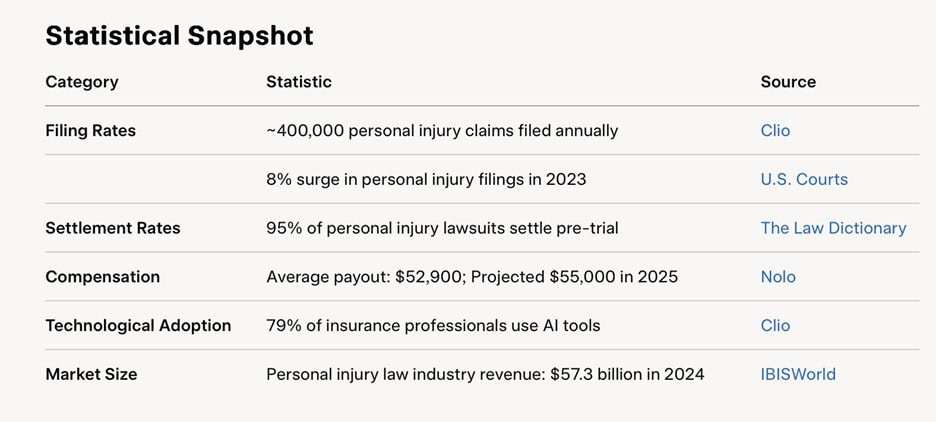
Each year, approximately 400,000 personal injury claims are filed across the United States, seeking compensation for injuries from car accidents, workplace incidents, medical malpractice, and more. For insurance adjusters, tasked with evaluating these claims and determining fair settlements, staying ahead of emerging trends is critical. In 2025, personal injury law is undergoing a transformative shift, driven by technological advancements, evolving healthcare practices, new accident types, increased recognition of mental health injuries, and significant legislative reforms. These trends are reshaping how claims are processed, valued, and settled, presenting both opportunities and challenges for adjusters. This article explores five key trends and their implications, offering practical insights to help insurance adjusters navigate this dynamic landscape.
- Artificial Intelligence in Claims Processing
Impact on Adjusters
Artificial intelligence (AI) is revolutionizing personal injury claims processing, enabling insurance companies to analyze vast amounts of data quickly. Tools like Shift Technology and Snapsheet evaluate medical records, estimate damages, and detect potential fraud in minutes, streamlining adjusters’ workflows.
However, AI introduces challenges. Algorithms may undervalue non-economic damages, such as pain and suffering, or exhibit biases favoring insurers, potentially leading to unrealistic settlement expectations. Additionally, over-reliance on AI can overlook case-specific nuances, requiring adjusters to apply human judgment to ensure equitable outcomes.
What Adjusters Can Do
To leverage AI effectively, adjusters should:
- Learn AI Tools: Familiarize themselves with their company’s AI platforms, understanding data inputs and outputs.
- Ensure Transparency: Advocate for explainable AI processes to verify decision-making logic.
- Apply Expertise: Review AI-generated assessments critically, adjusting for factors like emotional distress or unique circumstances.
- Stay Trained: Participate in AI training programs to stay updated on advancements and limitations.
By balancing AI efficiency with human oversight, adjusters can enhance claim accuracy while protecting claimant rights.
- Telemedicine and Medical Evidence
Impact on Adjusters
The rise of telemedicine, accelerated by the COVID-19 pandemic, has led to a surge in personal injury claims supported by virtual medical consultations. Telemedicine records are increasingly used as evidence, offering convenience but raising questions about their thoroughness compared to in-person examinations. Insurers may challenge these records, arguing they lack the depth needed to substantiate injury claims.
Some states have enacted laws to ensure telemedicine evidence is treated equally in legal proceedings, leveling the playing field. For adjusters, this means navigating a patchwork of regulations while assessing the reliability of virtual medical evidence.
What Adjusters Can Do
To evaluate telemedicine-based claims effectively, adjusters should:
- Verify Provider Credentials: Confirm the qualifications of telemedicine providers to ensure credibility.
- Assess Record Completeness: Check for detailed examination notes, diagnostic tests, and follow-up plans.
- Understand State Laws: Stay informed about state-specific regulations on telemedicine evidence admissibility.
- Seek Additional Evidence: Request in-person evaluations when telemedicine records are insufficient.
By developing criteria for assessing telemedicine records, adjusters can help ensure accurate claim evaluations while complying with legal standards.
- Rideshare and Autonomous Vehicle Accidents
Impact on Adjusters
The proliferation of ridesharing services like Uber and Lyft, alongside the gradual adoption of autonomous vehicles, is complicating personal injury claims. These accidents often involve multiple parties—drivers, rideshare companies, vehicle manufacturers, or software developers—making liability determinations challenging. For example, in rideshare accidents, adjusters must determine whether the driver was on duty and which insurance policy applies. Autonomous vehicle crashes raise questions about software glitches, manufacturing defects, or human error.
Evolving legal precedents and insurance products add further complexity, requiring adjusters to navigate uncharted territory when assessing these claims.
What Adjusters Can Do
To handle rideshare and autonomous vehicle claims effectively, adjusters should:
- Conduct Thorough Investigations: Determine the accident’s circumstances, including driver status or vehicle mode (manual vs. autonomous).
- Understand Insurance Policies: Familiarize themselves with rideshare and autonomous vehicle insurance, which may differ from standard auto policies.
- Collaborate with Experts: Work with technology or transportation law specialists to analyze complex liability issues.
- Monitor Legal Developments: Stay updated on case law and regulations governing these emerging technologies.
By building expertise in these areas, adjusters can better assess liability and expedite claim resolutions.
- Mental Health Claims
Impact on Adjusters
Personal injury law is increasingly recognizing mental health injuries, such as post-traumatic stress disorder (PTSD), anxiety, and depression, as compensable damages. This shift reflects a broader societal understanding of trauma’s long-term effects, with more claimants seeking compensation for psychological harm. However, evaluating mental health claims is challenging due to their subjective nature, often lacking objective medical tests.
Adjusters must navigate complex evidence, including therapy records, expert testimony, and claimant narratives, to assess the validity and severity of these injuries.
What Adjusters Can Do
To evaluate mental health claims effectively, adjusters should:
- Engage Mental Health Experts: Collaborate with psychologists or psychiatrists to understand the impact of trauma.
- Gather Comprehensive Evidence: Collect therapy records, diagnostic reports, and detailed claimant statements.
- Stay Informed: Learn about current diagnostic criteria (e.g., DSM-5) and treatment methods for mental health conditions.
- Build Expert Networks: Develop relationships with trusted mental health professionals for reliable assessments.
By honing skills in this area, adjusters can help ensure accurate evaluations of mental health claims.
- Tort Reform
Impact on Adjusters
Tort reform efforts are reshaping personal injury litigation across the U.S., with states like Georgia leading the charge. Georgia’s Tort Reform Act, signed on April 22, 2025, introduces caps on non-economic damages, modified liability rules, and stricter filing deadlines, aiming to reduce frivolous lawsuits.
These changes directly affect claim valuation and processing; potentially lowering settlement amounts. Adjusters must adapt to these new frameworks to ensure compliance and accuracy.
What Adjusters Can Do
To navigate tort reform effectively, adjusters should:
- Monitor State Laws: Regularly review legislative updates in their operating states.
- Adjust Valuation Methods: Account for damage caps and new liability standards when estimating settlements.
- Ensure Compliance: Align claim processing with updated legal requirements to avoid disputes.
- Participate in Training: Attend industry seminars or webinars on tort reform impacts.
By staying proactive, adjusters can maintain efficiency and fairness in claim handling amidst legal changes.
Conclusion: A Call to Action
The personal injury law landscape in 2025 demands that insurance adjusters adapt to a rapidly evolving environment. AI offers efficiency but requires oversight to prevent biases. Telemedicine evidence necessitates new evaluation strategies, while rideshare and autonomous vehicle accidents challenge traditional liability assessments. Mental health claims call for specialized expertise, and tort reform alters claim valuation dynamics. By embracing these trends—through training, collaboration with experts, and proactive engagement with legal changes—adjusters can significantly enhance their effectiveness. As personal injury law continues to evolve, staying informed and adaptable is not just an advantage—it’s a necessity.